
Capstone showcase-winning video game takes golf challenges to next level
 May 5, 2026
 As a sport that is jokingly referred to as 'a good walk spoiled', golf was already a perfect fit for a Foddian video game — a genre designed to frustrate and enrage players by punishing the smallest of mistakes.
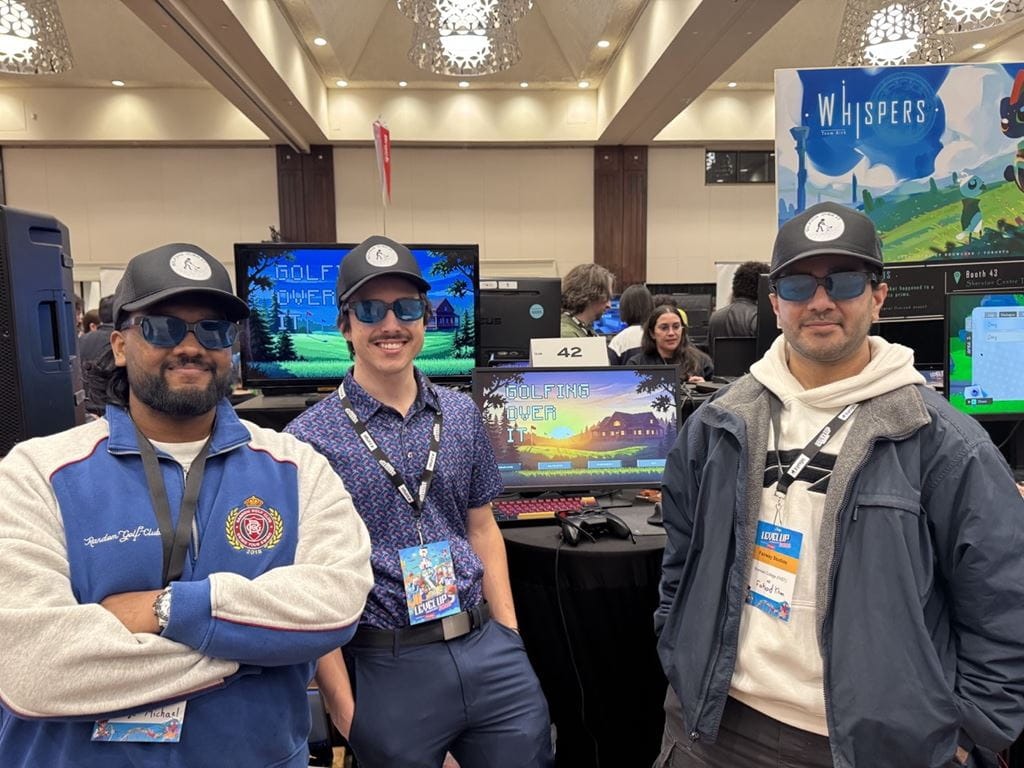
Honours Bachelor of Computer Science game engineering students Obadiah Siebert, George Michael and Fahad Khan took things a level further when building a golf video game as their fourth-year capstone project: incorporating anaglyph rendering that makes it even more difficult for players to be successful.
 "In the multiplayer mode, players wear modified 3D glasses — one pair with two blue lenses and the other with two red lenses — that filter out the coloured game objects corresponding to each player's glasses tint," explained Siebert. "The asymmetry of some obstacles being visible and interactable by only one player forces the players to communicate and work together to advance through the level in a best-ball format. Each player takes a shot, then has to vote for which location they want the next shot to occur from, without being able to see what their partner's shot will look like."
The game, titled Golfing Over It as a nod to the 2017 video game Getting Over It with Bennett Foddy, won both the Game Engineering division and the overall first prize at the Computer Science degree's recent capstone showcase event at Trafalgar Campus. Siebert, Michael and Khan also had the opportunity to exhibit their game at the recent Level Up provincial game design competition in Toronto, where some attendees stayed at their booth for nearly an hour, determined to beat the level.
"This was the largest long-term project of our educational careers, so knowing how to collaborate was really important," Siebert said. "The diverse curriculum of Sheridan's Computer Science program also required us to quickly become proficient in many skills, languages and technologies. This allowed us to tackle complex problems like enabling users to properly calibrate anaglyph rendering settings to their monitor's unique colour temperatures and setup's ambient lighting."
The Computer Science capstone showcase also featured winners in two of the program's other areas of specialization: Cloud Computing and Data Analytics.
Inclusive supports for first-time parents


Eshraj Kaur Dhanda, Nancy Verma and Vibhor Kinnareshkumar Patel won the Cloud Computing division for ParentPrep+, a scalable, AI-powered platform designed to support first-time parents through personalized guidance on baby preparation, nutrition safety and mental health.
Key features of the app include a real-time food and drink safety scanner, an AI-powered chatbot for contextual parenting support, and community-driven mental health forums. AI and machine learning are leveraged to provide image recognition for food safety analysis, natural language processing for personalized recommendations and chatbot interactions, and tailored insights based on user behaviour and preferences.
“A key differentiator of ParentPrep+ is its focus on combining intelligent automation with culturally inclusive and personalized support, addressing the fragmented nature of existing parenting resources,” Dhanda said, adding that the app ensures user trust and safety through secure authentication, encrypted data storage and controlled access to sensitive information.
“One of the biggest things we learned in this project was how to design and build a scalable cloud-native system from end to end, including making key architectural decisions early on — like choosing a serverless approach using AWS Services and how to integrate AI responsibly while still maintaining useful context for users."
Optimizing fraud investigation processes
 The winning Data Analytics project was a secure, cloud-native platform that uses Explainable AI (XAI) to make manual fraud investigation processes more efficient.
Marko Tanasijevic, Mat Nocera-Iozzo and Tauheed Shams Tabrez Attar's Financial Retrospective Analytics and User Decision System (F.R.A.U.D.S.) runs three models simultaneously to assess the likelihood of fraudulent transactions, then produces two reports: a spreadsheet of detailed findings for use by data analysts, and a high-level PDF summary that can be understood by anyone.

"For every $1 that is lost to fraud, it costs banks more than $4 in labour and operational expenses. Our product is a shift from the traditional fraud detection system used by most banks — a black box system that tells you 'yes' or 'no' but doesn't tell you why — and can reduce the investigation process from 60 minutes to 60 seconds," said Attar.
"This project applied the knowledge we gained in data analytics and machine learning courses. We also saw why it's so important to learn math in computer science. Even if we're not calculating simple equations, understanding statistics helps."
Projects connect technology with real human needs
 Other capstone projects created by this year’s Honours Bachelor of Computer Science graduating cohort addressed challenges in diverse areas such as mental and financial health, energy management, location scouting and wildfire response systems.
“I am very proud of our students’ use of advanced areas of computer science — including AI, machine learning, natural language processing, data analytics, procedural content generation and Internet of Things — to produce practical and creative solutions to real-world challenges,” said Honours Bachelor of Computer Science professor and capstone coordinator Shalini Singh Jaspal.
“These solutions were created for a broad range of users, including fraud analysts, academic advisors, content creators, first responders, new parents, software developers, gamers and game developers, and golf enthusiasts. Working in teams, students transformed complex ideas into practical, user-friendly tools that demonstrate not only strong technical expertise but also a clear ability to connect technology with real human needs.”
Sheridan's Honours Bachelor of Computer Science degree teaches fundamental computer science skills that prepare graduates to work in all areas of computer science, both now and in the future. Students also take eight specialized courses in a growing field of computer science that interests them most — cloud computing, data analytics, data engineering, game engineering and artificial intelligence — to gain specific skills not taught in traditional diploma and degree programs. The Honours Bachelor of Computer Science shares many core courses with Sheridan’s Honours Bachelor of Computer Science (Mobile Computing) degree (including fourth-year capstone projects), making it easy for students to transfer from one program to the other.
— Pictured in article are (top to bottom, from banner) Obadiah Siebert, George Michael and Fahad Kahn displaying their Golfing Over It video game at Level Up; the anaglyph rendering glasses used in their game; Eshraj Kaur Dhanda, Nancy Verma and Vibhor Kinnareshkumar Patel standing with Computer Science professors El Sayed Mahmoud and Shalini Singh Jaspal; a screenshot of the ParentPrep+ app; Tauheed Shams Tabrez Attar explaining F.R.A.U.D.S. to a showcase attendee; a screenshot from the F.R.A.U.D.S. platform; and two people looking at a cloud-based wildfire response system. Photos of Tauheed Shams Tabrez Attar and cloud-based wildfire response system screen by Marianne Sy-Lucero, Sheridan Digital Communications Officer; all other photos submitted.
Media Contact
For media inquiries, contact Sheridan’s Communications and Public Relations team.