
Game Design students win big once again at Level Up Showcase
 Apr 28, 2026
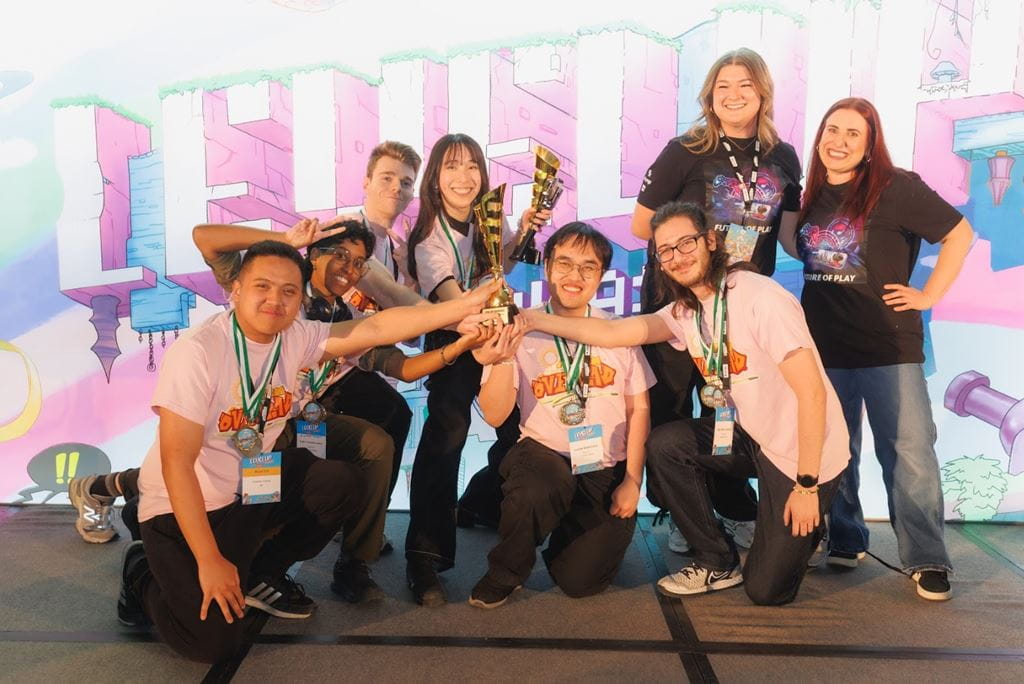
 Sheridan Honours Bachelor of Game Design fourth-year students have once again claimed the prestigious Best Overall Game award at the Level Up Showcase, an annual competition and exhibition for post-secondary game design students from across Ontario.
The team of Lucas Altamirano, Marc Corpuz, Ben Dryburgh, Sadira Kooblal-Caesar, Chloe Mui and Axel Vera Jimenez won the award for System Overload, a hand-drawn acrobatic platformer about parrying (deflecting) enemy bullets and turning them into your own. They are the second Sheridan team in as many years to win Best Overall Game at Level Up, a showcase in which Sheridan students have enjoyed tremendous success over the years.
Other Sheridan student-designed games to win divisions at Level Up were Aroma (Innovating Technology) and Gimme A Hand! (Achievement in Audio). Aroma added a third-place finish in Best Overall Game, System Overload placed second in Artistic Achievement, and Riding Shotgun was third in the People’s Choice division.
Gimme A Hand! was created through a collaborative co-op project involving four Sheridan students and four computer science students from the University of Toronto. All of Sheridan's other entries were capstone projects completed during Game Design students' fourth year of studies.
“Winning three divisions and six awards at Level Up, a competition that featured more than 20 schools and 160 games, is a tremendous achievement,” says Jeffrey Pidsadny, coordinator of Sheridan’s Honours Bachelor of Game Design degree. “We are proud that our students continually demonstrate their ability to produce compelling experiences that are recognized in their award-winning capstone projects.”
System Overload (first in Best Overall Game, second in Artistic Achievement)
 The seeds for System Overload were planted long before the student team, which goes by the name Since 213, began its capstone project last fall.
“In our second year of the program, we were all sitting in Room S-213 (a room in Sheridan's SCAET Building after which the team is named, honouring the space where the group regularly gathered outside of class) and realized that we had a really strong bond," says Mui. "People underestimate just how much a group bond can help you get through a project like this."
So did Game Design degree classes that taught conflict resolution, empathy, communication and other soft skills. "When we took a first-year course about being a good team member, I didn't understand the point of it at the time, but it helped us foster psychological safety and learn to work together, similar to a game design studio," Corpuz says.
The group acknowledges that System Overload's gameplay was initially simple — requiring players to move forward, jump and occasionally hit the parry button. "But we polished and expanded those mechanics to their fullest extent in order to make them feel as good as possible," Altamirano says. "It feels good to play our game, it feels satisfying. It's not complex or complicated, but it doesn't have to be in order to feel good."
Being recognized for the game's art was a pleasant surprise as well. "System Overload has a bold style, skater-culture and comicky, a groove and sass that stands out," Mui says. "I and the other artists had an absolute field day concepting and coming up with the sketches and letting our pens run free. It's messy, it's honest and, in a world where human art is valued now more than ever, it resonated."
"We didn't set out to win Best Overall Game or any other award when we started this project," adds Vera. "Our two goals were to create a strong portfolio piece and to create something that could be played from start to finish. We accomplished both of those goals, and the Level Up awards were a byproduct."
The awards also unlock confidence and motivation for the team to continue working on the game beyond graduation. "We were friends before we started this project, and we'll remain friends after it," Kooblal-Caesar says. "And maybe we'll continue developing the game as well."
Just not in S-213 anymore.
"We're really going to miss that room," Dryburgh says.
Learn more about System Overload by visiting the game's page on Steam, where you can also wishlist it.
Aroma (first in Innovative Technology, third in Best Overall Game)
Aroma — a 3D isometric puzzle adventure game in which a hamster collects ingredients to creates dishes that unlock various abilities and magical effects — also wasn't designed with awards in mind. In fact, once members of the Eyelipop team realized that Level Up judges would only experience each game for a short amount of time, they felt their chances of winning an award were even slimmer.
"Aroma is built around exploration, cooking and gradual discovery. A lot of its appeal comes from the way the full experience unfolds over time, rather than from a single brief moment," says Gabriel Xiao, the project lead who also designed levels and sound. "It was created because we wanted to make a game that genuinely belonged to us — one that reflected the kind of experience we ourselves wanted to play. That is why our two awards mean so much to us: they feel like recognition not only of the final build, but also of the creative direction we remained committed to."
 The team attributes its Innovating Technology division win to the way Aroma's mechanics are designed to constantly interact with one another, rather than existing as isolated abilities. Each power that players obtain is part of a larger gameplay system. For example, if a player's path is blocked by toxic fog, the player can use wind to disperse it, fire to ignite it and trigger an explosion, or even combine abilities to set a bone on fire and then throw it to ignite the fog from a distance.
 Another of Aroma's strengths is its overall cohesion, which the team believes was a key factor in the third-place showing in Best Overall Game. "The hamster protagonist, whimsical fantasy world, cooking-driven progression, environmental puzzles and game's warm, yet mysterious tone all supported the same type of experience," Xiao says. "One of the biggest strengths of Sheridan's program is a systematic, step-by-step teaching approach that helped us gradually find the direction that suits us best and allows us to contribute effectively. Each team member could go deeper into their own area of responsibility while still collaborating toward the same larger vision."
Although Eyelipop team members are excited about Aroma's potential, they are hitting the pause button on further development — at least for now.
"The distance between a capstone project and a marketable product is a long one. At this stage, we see Aroma as a highly polished, clearly directed and promising prototype," Xiao says. "Our main priority right now is to enter the industry, continue gaining experience and keep growing through real-world projects. And one day, when we come back together with more experience, we will be very happy to continue this little hamster's journey."
Other members of the Eyelipop team are Jiawei Peng, Zheyuan Zhang, Yubing Guo, Guanrui Zhu and Yanjun Ding. Learn more about Aroma by visiting the game's webpage on Itch or viewing the game trailer on YouTube.
Gimme A Hand! (first in Achievement in Audio)
When Mario Ciaralli was tasked with overseeing sound design for a game he and three Sheridan classmates were creating in collaboration with University of Toronto computer science students, he had immediate concerns.
"I was afraid that I might fail my teammates, including some that I hadn't even met," he says. "I was also worried about how people might react to my work in an area where I didn't have very much experience."
 Especially in designing audio for a project like Gimme A Hand!, a cooperative obstacle course game in which players control the limbs of an octopus as it tries to escape its tank. Ciaralli's creative approaches to simulating an aquatic environment included recording the sounds of water being poured into a bucket and bubbles being blown through a straw.
"I also had to account for ambient noises that take place underwater and the way sound changes when the octopus gets out of the tank," Ciaralli says. "I learned a lot about balancing sounds and making them work together, since you don't want to overwhelm players by having too many sounds at once.
"Helping my team win the Achievement in Audio award at Level Up really opened my eyes," he adds. "People told me that I would be good in this role, but receiving an award makes you realize that you actually can be. Being recognized for something in which I had so many doubts was a very touching moment for me."
The Octogroup team also includes Aunonna Kazi, Sydney Smith, Thales Nagato, Zein Sulayman, Arvin Gingoyon, Jiaxin Li and Chris Shin. Download Gimme A Hand! and learn more by visiting the game's webpage on Itch.
Riding Shotgun (third in People’s Choice)
The goal of Riding Shotgun is to drive across the Mojave Desert to Las Vegas, mowing down hordes of relentless demons on the way to Sin City.

In addition to designing and building the collaborative car combat game, the Dust Devils team went the extra mile of building a wooden arcade cabinet to house Riding Shotgun — a move that paid off with a third-place finish in the People’s Choice category.
“Our worst fear was getting relegated to a tiny laptop in a corner of the convention floor, and we knew a physical arcade cabinet would be eye-catching and stand out amongst the crowd,” says Charlie Tipping, who directed sound and also worked as a 3D and user interface (UI) artist. “With this in mind, we also developed our core gameplay around being ‘very pick up and play’ so we’d always have a decent crowd around the machine, and it worked!”
Also key to the team’s success was an ability to define a firm plan and then stay committed to it, something Tipping says is emphasized at Sheridan. “The program also does an amazing job of assisting with networking because of how well acquainted you become with your peers through various projects,” he adds. “Beginning in your first year of studies, you’re subconsciously figuring out which partners you’d work best with on your fourth-year capstone.”
Other members of Dust Devils are Gleb Belyakov, Matt Fitzgerald, Shaun Dinkin, Vai Verma and Sydney Smith. Learn more about Riding Shotgun on Itch.
Sheridan's Honours Bachelor of Game Design program was the first four-year game design degree in Canada, teaching skills in game design and mechanics; level design; programming and technology; game narrative and audio; 2D and 3D art and animation; and professional development and project management. Theory is reinforced through a variety of applied learning exercises and experiences, including case studies, simulations, lab projects, a co-op work term and a fourth-year capstone project developing a game.
Media Contact
For media inquiries, contact Sheridan’s Communications and Public Relations team.