
Mechanical Engineering capstones address challenges in manufacturing, agriculture and environmental sectors
 Apr 20, 2026
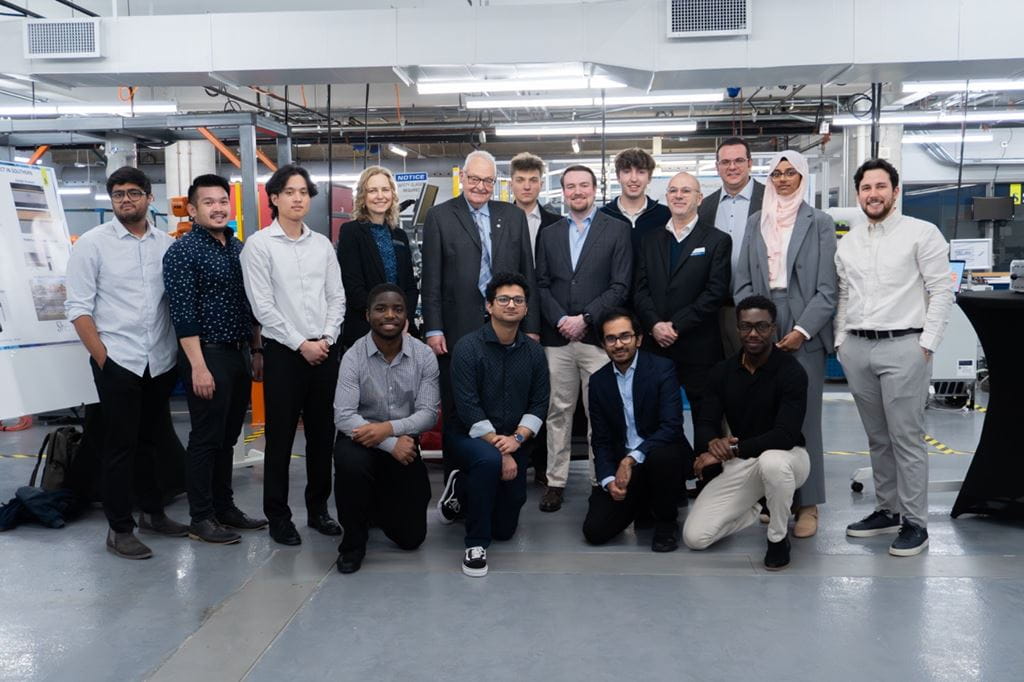
 As the former chief designer for National Steel Car Limited and a recipient of a Premier’s Award for Technology, Dr. Jim Forbes, P.Eng. (Mechanical Engineering Technology ’71) recognizes creative, purposeful and impactful design when he sees it. And he likes what he sees from this year’s graduating cohort in Sheridan’s Honours Bachelor of Engineering (Mechanical Engineering) degree program.
“The point of engineering is to deliver products to society,” Dr. Forbes said after serving as the guest judge at Sheridan’s Mechanical Engineering fourth-year capstone showcase earlier this month in the Centre for Intelligent Manufacturing at Davis Campus. “These students’ projects are all micro examples of what macro engineering is, and Sheridan’s students are all very articulate, enthusiastic and ambitious. I would say Canada and Ontario are in good hands.”
Retired electrical engineer Anand Jain, Director of the Vijay Anand Foundation that supports awards and scholarships within Sheridan’s electrical and mechanical engineering programs, also attended the showcase to see student designs that addressed real-world challenges in the manufacturing, agriculture and environmental sectors. The winning project was a machine that can be used to improve the testing of furnace refractory walls, making the process safer and more consistent.
“I liked both its level of detail and its simplicity, and it’s a concept that can be scaled to become a device that is useful to industry,” Dr. Forbes said of the first-place project. “But all of these students were winners.”
“A key strength of the capstone experience is the focus on industry-driven projects that expose students to authentic requirements, standards and expectations, ensuring their work is grounded in practical application,” added Dr. Andy Alubaidy, coordinator of the Mechanical Engineering degree. “I was very impressed by the caliber of work done by this year's graduating cohort. Their innovative solutions have potential to inform and improve the ways in which real-world partners can navigate various challenges.”
Improving testing of furnace refractory walls
For the past three decades, global engineering and consulting firm Hatch has used Acousto Ultrasonic-Echo (AU-E) technology — a method that detects material density through the transmission of high-frequency sound waves — to monitor the integrity, thickness and material conditions of refractory walls inside industrial furnaces.
To create those sound waves, human operators typically enter small high-temperature environments and strike the furnace wall with a hammer. Hatch, which is currently collaborating with CIM on multiple projects and has worked in partnership with Generator at Sheridan research centres for more than 10 years, turned to Sheridan's Mechanical Engineering program seeking a solution that removes the need for operators.
“I really liked this project because we have a goal at the end — criteria, a task to accomplish.”
– Honours Bachelor of Engineering (Mechanical Engineering) student Damian Wozniak
Osazuwamen Osa, Giovanni Lopiparo and Damian Wozniak were happy to take on the challenge. "I really liked this project because we have a goal at the end — criteria, a task to accomplish — instead of theoretically imagining various ways you could do something," Wozniak said. "We're not reinventing the wheel of engineering, we are trying to solve an actual problem."
Needing to generate an adequate amount of force within a confined space, the students designed a machine that uses a motor, twin springs and a modified pinion with teeth on one side. When the pinion's teeth are disengaged, a rack flies forward and a metal ball strikes the furnace wall.
"Each semester of our studies taught us something new about each of these components and how they'd interact and behave in high-stress situations," Osa said. "I remember wondering how much we might use springs, and now we're using them to solve a real problem. We also applied programming skills we learned in our mechatronics system to build an electronics box using Basic C coding."
Spot-testing silage quality
Studies have shown that the milk production of cows is more dependent on food quality than food quantity. But how can dairy farmers ensure that the forage they're feeding their animals provides optimal levels of digestibility and energy supply, especially when that food is tightly compacted for fermentation?
Addressing that question was the task of Matthew Mcghie, Haanee Hafsah Jaufuraully, Faizan Baig and David Ngolayefa Ayerite, who partnered with Hamilton, Ont.-based Grain Data Solutions to design a device that can spot-test farming silage. "Most current methods of silage analysis are expensive, difficult and time consuming, including having to cut out a chunk of silage with a chainsaw," said Mcghie. "We wanted to create a system that can measure various properties of silage throughout the storage container."
The group's first idea involved a static-based design that distributed sensors throughout a silo, but Grain Data Solutions wanted a portable handheld device that could produce increased accuracy and integrity. That inspired a powerdrill-based design that meets Canadian ergonomic standards for power tools and features several long probes — each of which detects different conditions such as moisture levels and temperature.
“I never imagined I'd try to revolutionize the world by stabbing silage.”
– Honours Bachelor of Engineering (Mechanical Engineering) student Matthew McGhie
Beyond making the tool large enough to integrate all the sensors needed to produce one coherent reading, the group also had to ensure it was IP67 proof (able to withstand wet and dusty conditions) and durable enough to penetrate the extreme density of silage. "We considered designing it to have one long probe, rather than three separate ones, but that seemed too complicated to manufacture," Baig said. "And for troubleshooting and maintenance, it'll be easier and more efficient to replace one probe at a time than all of them at once."
Another key learning from the project was the value of allocating tasks based on individual strengths. Mcghie was responsible for CAD modeling; Ayerite specialized in material analysis; Baig led creation of sensors and other electrical components; and Jaufuraully focused on development of the moisture probe.
"I think it would be exciting to visit a dairy farm with this physical creation," Mcghie said. "I never imagined I'd try to revolutionize the world by stabbing silage."
Cooling cities by combatting urban heat island effect
Green roofs, increased tree canopies and the use of lighter-coloured, water-absorbent or reflective building materials are among the tactics cities across Canada and throughout the world are using to combat urban heat island effect — a phenomenon that makes major centres warmer than surrounding rural areas and often attracts pollutants.
Daniel Ta, Maksym Czobot and Nirav Mistry imagined another creative approach: installing systems of cold-water pipes below parking lots to cool asphalt that can reach temperatures of 60C in the heat of summer. The duo created a small-scale solution that it could use to run simulations, then applied that experimental data to design a larger-scale solution that it plans to share for consideration by Toronto city government.
 "We've learned a lot about heat transfer analysis in our program — how to conserve heat and how to cool things that are too hot — so this project definitely plays to our strengths," Ta said.
The Conceive, Design, Implement and Operate (CDIO) framework the trio was taught at Sheridan was also key to the project. "We understand how to approach a problem systematically," Ta said. "We started with flow diagrams to build a model that assesses how hot asphalt can get, which then informed our next model testing how much heat pipes would need to move, which then informed our simulations."
Converting vehicles' waste heat into electricity
Increasing the efficiency of automobiles is an ongoing priority throughout the world, especially as gas prices and carbon dioxide emission reduction efforts continue to escalate.
Crimson Endaya and Krish Nitin Bhatt spent their capstone project exploring one small way to address that challenge: using thermoelectric generators (TEGs) to convert waste heat from vehicles (such as exhaust) into electricity that can ease the load on alternators and reduce engines' rotations per minute (RPMs.)
"Approximately 60-70 per cent of the energy used by cars is wasted," said Endaya. "By converting the difference between the heat produced by cars and the cold airflow that surrounds them, these generators could produce enough energy to run an independent system like an infotainment system or a phone charger."
 Initially, the team designed a system that attached TEG modules to the catalytic converter (CAT), but the students found the CAT's surface area to be too small. They tried building a cage housing onto the CAT before realizing the housing reduced airflow, then landed on a final design that attached the modules to the muffler.
To test their system, the students set up heat syncs and modules under a heat gun that was scaled to between 150-200 degrees C, then pointed a fan at it to simulate the airflow of driving conditions. Their multimeter indicated energy production of 40 to 50 watts.
"There are some research papers that have been published about this subject, including a few that were published after we began our project, but there is no physical product available in the market right now," Bhatt said. "Those papers used different calculations but their answers were quite similar to what we found, so I think we are on the right track."
Sheridan’s Honours Bachelor of Engineering (Mechanical Engineering) degree offers a unique blend of theoretical and applied learning, preparing graduates who are ready to work with industry-standard technology from day one. In their third and fourth years of study, students specialize in either energy or mechatronics while sharing a common foundation in essential maths and sciences. In addition to the fourth-year capstone project, the program also features numerous co-op and internship opportunities that enable students to apply their learning in industry settings, discover their interests, explore employment opportunities and enhance their resumes.
Media Contact
For media inquiries, contact Sheridan’s Communications and Public Relations team.