
How a last-minute hackathon idea sparked firefighting innovation and Google recognition
 Aug 19, 2026
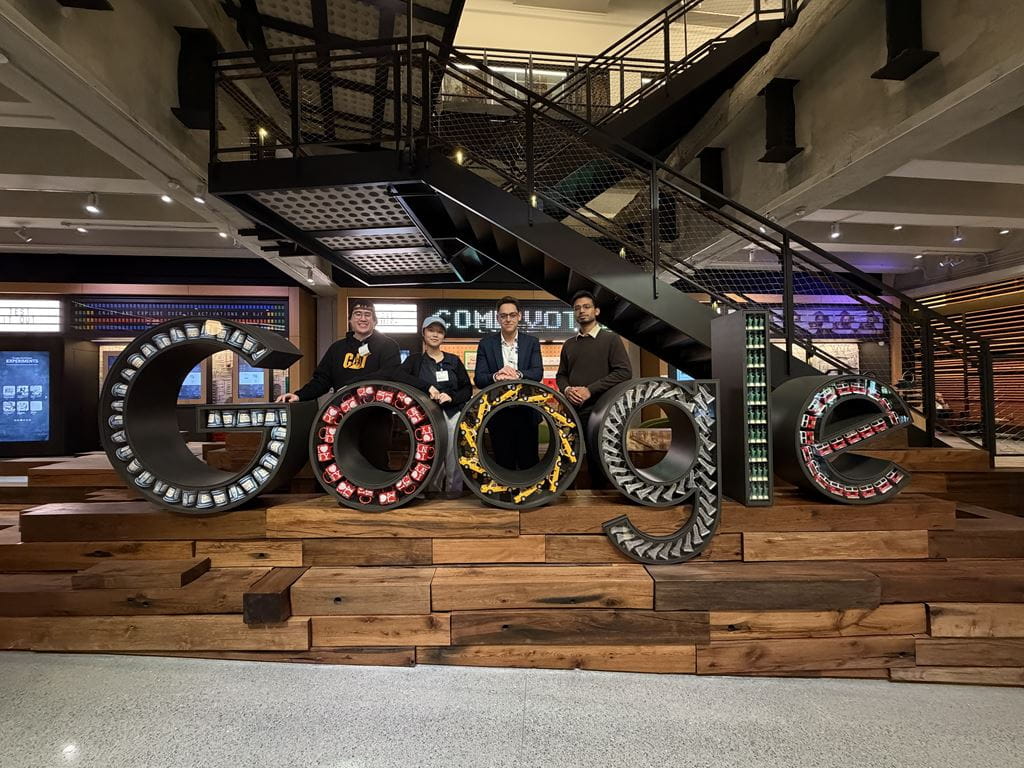
 Ember, an extended reality (XR) system designed to help firefighters and other first responders operate more effectively and safely in low-visibility environments, was recently named a top-three project at the Google Solution Challenge North America Demo Day — earning the IgnisXR team of George Farag, Taimoor Aleem, Yves Donato and Rita Zhang an invite to meet with Google engineers and demonstrate their product to a startup incubator this month in Manhattan.
Farag and Donato are students in Sheridan's Honours Bachelor of Computer Science degree program, Zhang is entering her second year in the Honours Bachelor of Interaction Design degree, and Aleem completed his Computer Science degree earlier this year.
"There are thousands of Google Developer Groups who submitted projects into this year's challenge, and we're proud to be the only Canadian team and only hardware project to finish in the top three," says Farag, who is also the president of Sheridan's Google Developers Group. "The feedback Ember has received from firefighters has reinforced that we are helping solve a real problem: inside a smoky building, firefighters can't see more than 15 centimetres in front of them. People are seeing the value in what we're doing."
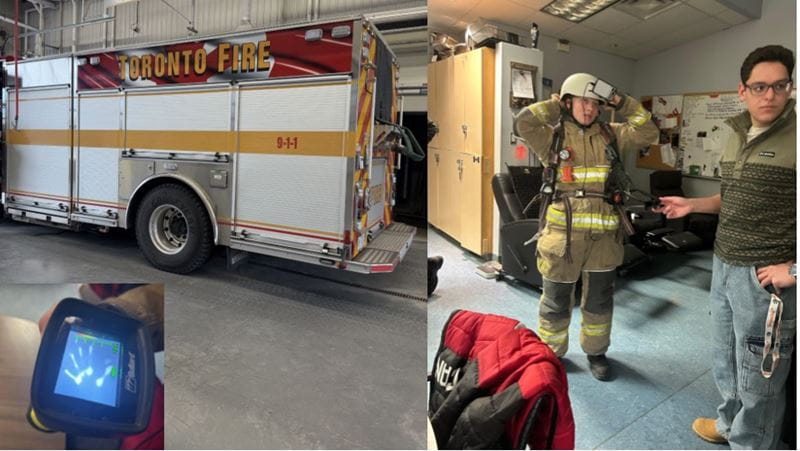
 Ember is a hands-free heads-up display that attaches to the standard SCBA masks that firefighters already wear. A LiDAR (light detection and ranging) depth sensor scans the environment ahead of the firefighter while an onboard computer runs machine-learning detection in real time. No internet connection is required, and it can help identify people through smoke and darkness, highlighting their location directly in the firefighter’s field of view through integrated AR glasses. A commander dashboard ties everything together, enabling an incident commander outside the building to see detections from every Ember-equipped firefighter and push alerts and directions back to individual displays via 3D elements like breadcrumbs and door highlights — providing crews a shared picture of a scene where visibility is near zero.
“The feedback Ember has received from firefighters has reinforced that we are helping solve a real problem... People are seeing the value in what we're doing.”
– Honours Bachelor of Computer Science student George Farag
The idea to merge LiDAR mapping, thermal vision and real-time analytics into a firefighter helmet was first born in March at Hack Canada in Waterloo. The students considered skipping that event because several of them had spent the day at a different function nearly 100 kilometres away in Mississauga, but ultimately chose to attend Hack Canada because it was a chance to hang out as friends. They arrived around 10 p.m., stayed up all night socializing and doing parkour, and didn't actually begin hacking until 7 a.m.
The decision to design an aid for firefighting was because Hack Canada tasked competitors with resolving a Canadian problem and the country has been stricken by severe wildfire seasons the past few years. Donato had a pair of AR/VR glasses with him that morning, prompting the group to begin thinking how that technology could be integrated into firefighting equipment. And Farag, who says he was "obsessed" with firefighters as a child, recalled conversations he'd had with them at fairs and during tours about how heavy smoke severely limits visibility.
Ember has since been pitched to various fire departments throughout the Greater Toronto Area and has also been demonstrated at several prominent industry events, including Shopify, Stan and the Canadian Undergraduate Technology Conference.
During its visit to Google’s St. John’s Terminal in New York, IgnisXR received feedback from several Google engineers and built connections with experts who could help further the development of Ember, including the Google team working on Android XR, an AI-powered operating system for headsets and glasses. Farag, Donato, Aleem and Zhang also enjoyed the opportunity to connect with fellow Google Solution Challenge North America winners from Hult International Business School and Virginia Tech. They also learned from a Google software engineer about the impact of artificial intelligence on computer science and received valuable résumé feedback and career advice from Google recruiters.
Now that the working prototype is complete, IgnisXR is actively seeking investment and strategic partnerships to support future hardware development and fund its next iterations.
 "We're diving into new areas like business and manufacturing, which is creating opportunities to learn so much," Farag says. "Ember and other hackathon projects are typically beyond the scope of what we learn in our classes, but Sheridan has given us a really special community where we know we're all very capable of working together and creating something special."
"It really is about the community," agrees Zhang, who founded her own student club — Women in Business and Technology — in her first year at Sheridan and has also received support from EDGE, Sheridan's entrepreneurship hub. "We have had so many opportunities outside of the classroom to learn about business and technology."
Learn about the creation and rapid success of Sheridan's Google Developers Group.
Media Contact
For media inquiries, contact Sheridan’s Communications and Public Relations team.