
Architectural Technology Studio at Sheridan: Designing meaning in the age of density
 Jun 30, 2026
 Cities are under pressure to build more homes, faster and cheaper. But architecture isn't just about numbers; it's about materials, how spaces feel and how people move through them daily.
The goal isn't simply to "build more." It's to build thoughtfully, even under pressure. In places like Ontario facing housing shortages, good design and building science don't become less important. Designers must balance speed with care, efficiency with creativity, and technical performance with human experience.
This is the intellectual and practical ground of Sheridan’s Architectural Technology Studio 6 course.
Learning to read the existing city
A core studio focus is adaptive reuse by finding new purposes for existing buildings rather than demolishing them. As cities densify, a cradle-to-cradle approach (designing out waste so materials are always recycled or reused) is both sustainably smart and helps retain the familiar.
Students learn to see older buildings as opportunities. Existing structures carry history and unique features that can inspire new designs. Rather than starting from an empty site, students analyze what's already there. They study a building's structure, how people move through it, the materials used, its environmental performance and its connection to the surrounding community. Using this information, students design solutions that balance creativity with practicality, respecting heritage requirements, while meeting contemporary needs.
This term, students were challenged to redesign a site in the Cooksville neighbourhood of Mississauga. The site includes two heritage buildings that must be preserved, giving students the opportunity to explore how new development can work alongside existing structures.
At the midpoint of the project, students presented their ideas during an event titled Design Carousel. Each student had 10 minutes to explain their proposal, answer questions, and receive feedback from invited guests as they moved around the room. This experience helped students strengthen their presentation skills, communicate their design decisions and respond to real-world questions and critiques.
“Our Architectural Technology Design Carousel is one of my favourite days of the semester,” said Faculty of Applied Science & Technology professor Shannon Pirie. “We are so lucky that our Sheridan community, our alumni network and our partners from the City of Mississauga come out to hear the students pitch their projects over and over again. The students really appreciate the real-time feedback they’re given by industry professionals and they always leave the event standing a bit taller and smiling a bit wider.”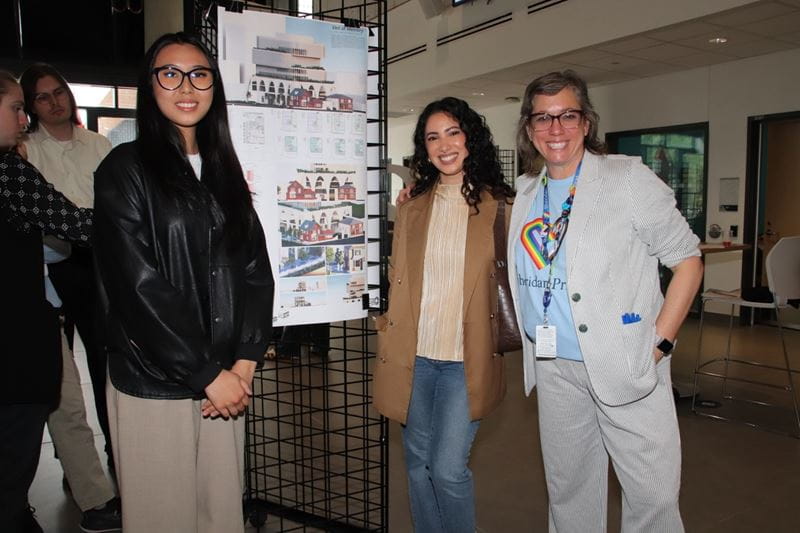
A world of inspiration
From the historic Cooksville brickyards to the Seven Wonders magnificence of the Hanging Gardens of Babylon, the concepts presented by the students reveal a wide range of creative thinking, connecting local history with bold ideas about how nature, buildings and communities can come together in new and imaginative ways.
 “I wanted my design to be a gift back to the community,” explained student Manolo Mendoza. His multi-use concept was inspired by the unwrapping of a gift, with large structural swoops representing ribbon and other facade treatments to suggest the revealing of a surprise underneath the wrapping.
“I watched this video of (Canadian-American architect) Frank Gehry crumpling a piece of paper and tossing it on the floor, saying ‘I can build that’. So, there’s inspiration from that,” Mendoza added as he spoke of what sparked his idea. Gehry, who passed away late in 2025, completed the critically acclaimed $276 million renovation and expansion of the Art Gallery of Ontario in 2008, and is known globally for breaking away from the rigid geometry of modern architecture.
Aseel Hamed, a Palestinian-Iraqi student, said she went into the project with her idea already in mind. “I knew I wanted to create something that was inspired by the famous Hanging Gardens of Babylon, and so I’ve introduced a lot of that feel with the spaces and garden aspects.”
The result is a layered structure, with an abundance of greenery and social spaces on each level, pulling in sustainability while maintaining a critical focus on community.
Density beyond the tower
A major learning outcome of the studio is the ability to think critically about density without defaulting to repetitive or generic typologies. Students are challenged to move beyond the assumption that increased density must mean high-rise repetition or displacement-driven redevelopment.
Students must work within limits like zoning rules, building size targets, structural needs, and the surrounding neighbourhood. Within those limits, they are still free to explore ideas about building design, materials, outdoor space, and how a project tells a story through space.
Balance is important. In real architecture work, designers rarely have complete freedom. They must solve problems creatively within clear restrictions, while still making buildings that work well and feel meaningful.

Third-year student Ced Jeudy explained that some of the challenges they had to deal with included the height of the proposed structure – which was restricted due to the size of the plot, along with municipal building requirements, such as no overhanding balconies allowed.
“That forced me to think about how I was going to approach my design. That’s why you see the terraced balconies.”
Jeudy’s design paid homage to Cooksville’s history as one of Canada’s largest brickworks from 1913 until it closed in the 1990s.
Creatively, Jeudy opted for structural brick masonry around a steel skeleton – although with some forward thinking on sustainability. “My proposal calls for the use of lime mortar, rather than Portland cement (a much harder mortar that often causes damage to bricks when it is removed). This allows for any future repairs or reuse to be done without having to manufacture as many new bricks. With Portland cement, bricks can’t be reused as consistently.”
From design thinking to professional readiness
Throughout the program, students build practical, job-ready skills that go beyond design ideas. They learn how building systems work together, how to apply codes and regulations, and how to communicate solutions through industry-standard drawings and documents, in both digital and analog forms.
They also develop critical thinking, collaboration, and problem-solving skills that mirror real project teams, where decisions must balance budgets, life-safety, construction constraints, and end-user needs.
Students learn how buildings are constructed in phases, how existing elements are carefully removed, and how old and new structures are combined; skills essential to renovation and adaptive reuse. This focus aligns with a broader push to reduce construction's environmental impact and greenhouse gas emissions, reflecting the program's commitment to sustainable outcomes.
Students in the Architectural Technology – Sustainable Design program can participate in an optional paid co-op. The co-op placement helps students gain real-life experience and make contacts in the architecture and construction industries.
Graduates of architectural technician and technology programs are not limited to traditional roles in the sector that include building documentation. They often move into urban design, construction, project management, facilities support, estimating, spec writing, sustainability and high-performance buildings, building science, real estate development, public policy, heritage conservation, digital design technologies and emerging fields such as spatial computing.
Graduates of the three-year Architectural Technology – Sustainable Design program qualify to legally use the term ‘Licensed Architectural Technologist’ by fulfilling requirements of the Association of Architectural Technologists of Ontario.
What connects all these paths is the same skill: being able to take complex problems and turn them into real spaces that can anchor a community, build social cohesion, and contribute to the fabric of the places we live in.
Sheridan's Architectural Technician - Sustainable Design diploma program arms students with practical skills and fundamental architectural knowledge needed to contribute to design, technology and management of small construction projects under the guidance of architects. The Architectural Technology - Sustainable Design advanced diploma features a third year of studies during which students work with real-world clients, build a portfolio and have the option to participate in a paid co-op placement. Both programs are taught out of Sheridan's Hazel McCallion Campus in Mississauga, a living lab with exposed architectural elements and a large library of sustainable building resources.
— Pictured in article are (from top to bottom, left to right) third-year Architectural Technology student Yasmina Yussapova, Sheridan graduate Aneliz Santos and professor Shannon Pirie; Manolo Mendoza; and Ced Jeudy. Photos by Cameron Wood.
Media Contact
For media inquiries, contact Sheridan’s Communications and Public Relations team.