
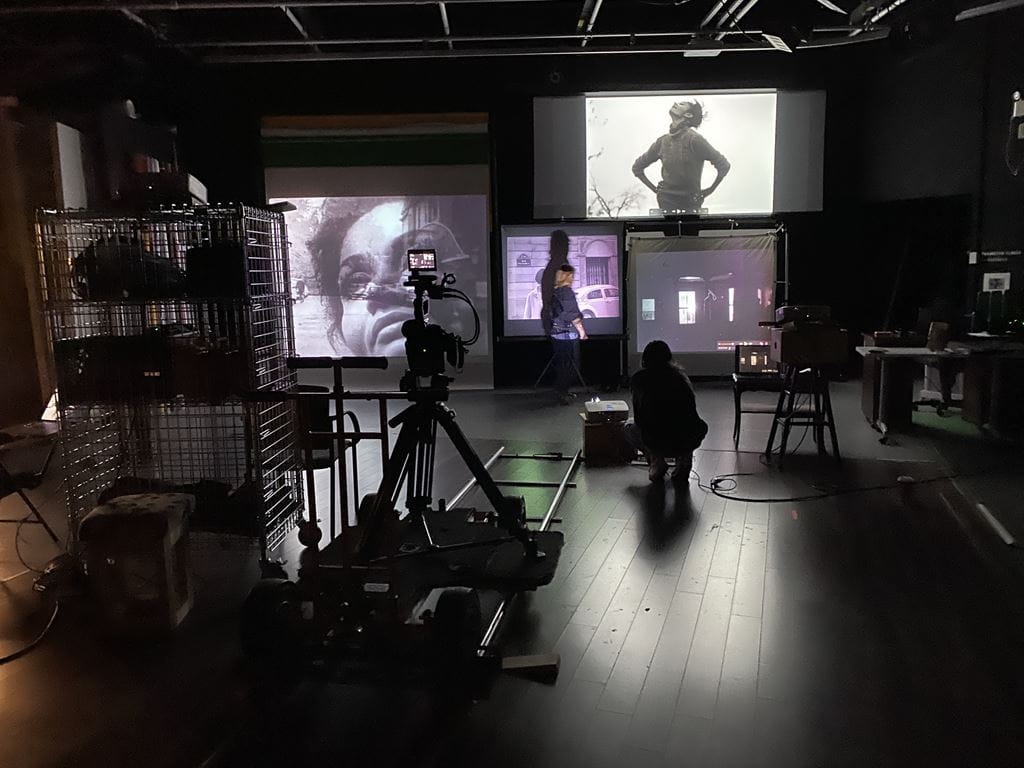
Reframing research in the arts: archival experimentation with classroom impact
 Feb 17, 2026
 Students in Sheridan’s Faculty of Animation, Arts & Design (FAAD) are encouraged to take creative risks — a mindset that is modelled by professors Nadine Valcin and John Kneller through their own research practices. Grounded in experimentation, creative-risk taking and the shared curiosity that emerges when distinct practices intersect, the duo’s research project “Les Rêves de Sabattier” not only advanced their personal artistic inquiry but also allowed them to bring lived research experience directly into the classroom.
 While their practices differ — Valcin’s work is grounded in fragmented documentary storytelling and archival inquiry, and Kneller’s in experimental celluloid filmmaking — the two came together on the research project with a shared ambition: to expand how archival materials are visually treated and understood. Through experimental film techniques, the project reanimates black-and-white photographic and moving image archives, resulting in a hybrid gallery experience that invites viewers to see history in a new way while also sparking dialogue around the artistic value of analog media in a digital age.
For Valcin, the project reinforced a deeply held belief that research is not exclusive to science, technology, engineering and mathematics (STEM) disciplines. As a media artist and filmmaker, she sees creative practice as a form of rigorous inquiry in and of itself. “Les Rêves de Sabattier” marked her first research project at Sheridan and offered an opportunity to step outside of demands of teaching schedules and production deadlines to focus on continuous experimentation.
“Sheridan started as a school with a focus on the arts, yet research is often equated with math and science,” Valcin said. “This project is a reminder that art is always an exploration and that it is important for faculty and students to seize the opportunity to pursue creative research outside of the activities that fill their regular academic calendar.”
 Kneller’s love for experimental film and celluloid practice stretches back to the 1980s, making this project a natural extension of a lifelong commitment to the medium. His research focused heavily on in-camera exposure techniques — processes unique to film that rely on physical interaction with material. Through superimposition and hand processing, the project’s images gained greater depth, history and layered meaning.
Funded by a Generator Growth Grant (internal awards that provide opportunities for Sheridan faculty members to pursue their research passions), the project enriched both artists’ creative practices. Its impact also extended directly into the classroom, with the research becoming a feedback loop that strengthened their teachings. Rather than focusing on experimentation as theory alone, the professors were able to draw on lived, current research experience to inform their lessons.
The collaboration also had tangible curriculum outcomes. Insights from the project led Valcin and Kneller to work together on modifications to the Honours Bachelor of Film and Television (BFTV) degree program’s third-year Experimental Practice course, integrating activities inspired by their research explorations.
“This project is a reminder that art is always an exploration and that it is important for faculty and students to seize the opportunity to pursue creative research outside of the activities in their regular academic calendar.”
– Nadine Valcin
Changes to the course included reframing assignments as open-ended ‘explorations — shifting the goal of the work from producing a technically polished final product to focusing on the process of creative risk-taking and experimentation. The course was also updated to include hand-processing workshops and film distress techniques that revisit analog traditions; multi-image superimposition; project-based installation inspired by performance and video art; and the opportunity to engage with emerging tools such as augmented reality, virtual production and generative AI. Together, these shifts re-center the course on a purposeful blending of experimental practices with both traditional and new-age technologies.
Valcin and Kneller’s collaborative work on “Les Rêves de Sabattier” demonstrates how applied research at Sheridan can be driven by artistic passion that directly informs curriculum. By actively engaging in experimentation themselves, the professors model curiosity and creative risk taking for their students — not as abstract concepts, but as lived practice. In doing so, Valcin and Kneller reinforce a culture where research and teaching are intertwined, and where courses evolve alongside faculty discovery.
Interested in learning more about how to get involved as a faculty or staff member in research, innovation and entrepreneurship at Sheridan? Visit sheridancollege.ca/generator
Pictured in body of article are Sheridan Faculty of Animation, Arts & Design professors Nadine Valcin (top photo) and John Kneller.
Media Contact
For media inquiries, contact Sheridan’s Communications and Public Relations team.