
Engineering beyond assumption: removing friction, revealing what matters
 Apr 27, 2026
 At Sheridan, innovation isn’t just encouraged — it’s expected.
This year, two teams of graduating students from the Honours Bachelor of Engineering (Electrical Engineering) program have taken that ethos to heart with their capstone projects: one that feels as much like science fiction as it does practical engineering, and the other that will have you standing on the shoreline going “Can I have a go?”
Levitation will change the factory flow
Conveyor systems are a backbone of modern manufacturing, moving materials through factories, warehouses, and distribution centres. But they come with limitations — chief among them, friction. Mechanical wear, energy loss, noise, and maintenance costs all stem from the simple fact that moving parts touch.
The Sheridan team of Adnan Ahmad Habeb, Cameron Boodram and Steve Massey set out to eliminate that friction for their capstone.
Based on an idea shared by their professor, Dr. Hooman Nabovati, P.Eng., the solution uses electromagnetic levitation to suspend and move objects along a track without physical contact. Instead of rollers or belts, the system relies on precisely controlled magnetic fields to lift and move items forward.
 Massey explained that the big difference between traditional conveyor systems and their concept lies in that movement. “Conveyor systems are generally one-dimensional, but with electromagnetic levitation, you can move a part forward and backward, left and right.” This creates the possibility of a full 360-degree journey of a part or product within a fabrication setting.
The result? A system with virtually no friction, significantly reduced wear-and-tear, and the potential for smoother, faster, and quieter operation.
Electromagnetic coils generate a moving magnetic field that interacts with conductive elements on a carrier platform:
- Levitation coils create an upward magnetic force, lifting the platform slightly above the track
- Propulsion coils generate a traveling magnetic wave, pulling the platform forward
- Control systems adjust the current in electromagnets to modify speed and levitation height
Massey explained that the engineering challenge lies in balance. Too little force, and the platform drops. Too much, and it becomes unstable as the magnetics want to twist away from each other.
Beyond the technical achievement, the implications are significant.
A frictionless conveyor system could:
- Reduce maintenance costs by eliminating moving mechanical parts
- Improve energy efficiency by minimizing losses due to friction
- Enable cleaner environments (no lubricants required)
- Increase precision in industries where smooth transport is critical, such as electronics or pharmaceuticals
It also opens the door to modular, reconfigurable manufacturing lines where items can be routed dynamically without the constraints of traditional belt systems.
Pooling data from waterways
There was a bit of friction, however, at the pond on Sheridan’s Davis Campus with the launch of the other capstone project — primarily from the resident Canada geese.
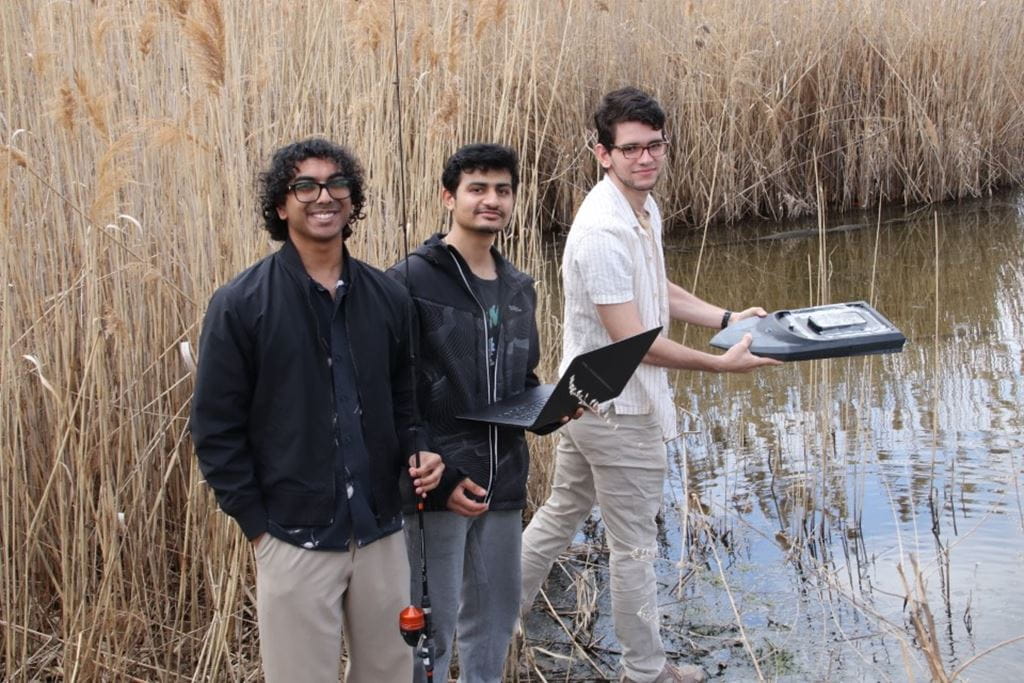
Abhinav Prasad, Megh Patel and Tiago Vitorino brought their 3D-printed robotic boat down to the water’s edge to test some of their own capstone theories.
 “If you've ever seen a lake or a body of water, and you've seen that it's kind of dirty, right?” asked Patel. “We won't know just by looking, is it safe for wildlife? Is it safe for the fish and everything there? What we wanted to do is to create a device that will sense different parameters to see if it's safe for wildlife to be in the water. And the parameters that we chose were pH level, the temperature and the turbidity; which is how easily light can pass through.”
The boat, itself, just buoys the core purpose of their capstone: a device that translates water conditions into something measurable and clear in real time. The value goes beyond technology; it’s the shift in how decisions get made. A portable, reliable sensing system gives conservation groups, municipalities, and researchers the ability to act on evidence, and act before harm becomes visible.
The control system uses a 4G module connected to a Raspberry Pi — a small single-board computer — to access the internet through a SIM card. That connection allows it to send SMS updates with the collected sensor data and system status. It also works both ways — users can send commands from their phone, such as triggering the device to collect a water sample.
The capstone required the team to integrate both electrical and mechanical systems. For example, the servo moves the flaps, but that requires careful coordination with motors, drivers, and power supply. The team had to calculate how much current the motor needs, determine the total power required, and then choose the right battery to run the system for the desired amount of time.
Adding to the complexity of the project, Dr. Nabovati explained that the team also had to take into consideration some environmental restrictions. “These guys also researched the issues of legality and access. Will you be going on private property, will you be going into sensitive wildlife areas. They did a lot of research on that.”
A quick test run in the pond proved their theory and brought smiles and cheers ... although the geese may not have been among the approving audience afterwards.
Both teams donated their research back to Sheridan.
What makes these capstones compelling isn’t just engineering and technology — it’s the mindset behind it: solving problems with real-world applications.
Capstone projects offer a powerful opportunity for students to innovate, collaborate, and demonstrate their readiness for careers in engineering, while building a strong technical portfolio that supports their academic and professional growth beyond graduation. Through this work, students develop not only technical expertise but also essential skills in communication, teamwork, leadership, project management, sustainability, engineering law and ethics, and professional practice, preparing them to graduate as well-rounded engineers ready to make a meaningful impact.
Sheridan’s Honours Bachelor of Engineering (Electrical Engineering) degree is the first Ontario college program of its kind to receive accreditation from the Canadian Engineering Accreditation Board (CEAB), a significant recognition that ensures graduates have the academic qualifications necessary for licensure as professional engineers (P.Eng.) in Canada. Unlock your future as a licensed Electrical Engineer at Sheridan as you engineer solutions to real-world problems, and step into your future with confidence.
— Pictured in article are (top to bottom, from banner) Megh Patel, Abhinav Prasad and Tiago Vitorino after a successful 'sail' of their capstone project in the Davis Campus pond; Steve Massey, Adnan Ahmad Habeb and Cameron Boodram working on their levitation-based conveyor system in one of Sheridan's labs; and Vitorino, Patel and Prasad preparing to launch their boat while professor Dr. Hooman Nabovati observes. Photos by Cameron Wood.
Media Contact
For media inquiries, contact Sheridan’s Communications and Public Relations team.