
From classroom to city: Advancing urban planning through applied research
 Jan 28, 2026
 As Canada’s cities continue to grow at unprecedented rates, the need for strategic, data-driven urban planning has never been greater. With many Canadians living in large urban centres and surrounding suburban municipalities expanding, rapid urbanization is placing increasing pressure on transportation systems, environmental sustainability and quality of life.
 Dr. Haya El Ghalayini, an Applied Computing professor within Sheridan’s Faculty of Applied Science & Technology (FAST), is helping address these challenges through applied research that blends artificial intelligence (AI), machine learning and mobility data to support more sustainable urban planning decisions.
Motivated by a desire to address pressing societal challenges while creating meaningful innovation opportunities for students, El Ghalayini began her research journey at Sheridan in the fall of 2022. Since then, she has led two projects that not only support sustainable urban planning but serve as hands-on learning environments where students can gain experience working directly with industry partners on real-world challenges.
As Principal Investigator on the Natural Sciences and Engineering Research Council of Canada (NSERC)-funded ‘Town of Oakville Public Transit Mobility Project’, conducted through Generator at Sheridan’s Centre for Applied AI in partnership with Oakville-based data solutions and custom software development company Naryant, El Ghalayini worked alongside student researchers from Sheridan’s Honours Bachelor of Computer Science program to analyze travel patterns to and from Oakville GO Station, the second-busiest station in the Greater Toronto Area after Toronto’s Union Station. Using tools such as Python’s Pandas, Geopandas and Geoplot, the research team identified origin-destination patterns across multiple modes of transportation, generating insights that assist urban planners in better understanding how people move through the areas. These findings informed strategies aimed at reducing commuter travel times and encouraging the use of more sustainable public transportation options.
“Research allows me to bridge classroom learning with industry-driven challenges, providing students the opportunity to not only build practical skills but to see firsthand how the knowledge they acquire can be applied to shape community and industry.”
– Dr. Haya El Ghalayini
Despite the demands of managing complex research projects, El Ghalayini makes it a priority to show student researchers how their classroom learning translates into real-world impact. Through the ‘Town of Oakville Public Transit Mobility Project’ and her subsequent work, she mentored students through their research journeys, engaging them in all aspects of the process — helping grow their analysis, programming, experimentation, documentation and problem-solving skills. By working with real datasets and real stakeholders, her students have gained practical experience while contributing to outcomes that inform decision-making for municipalities and industry partners alike.
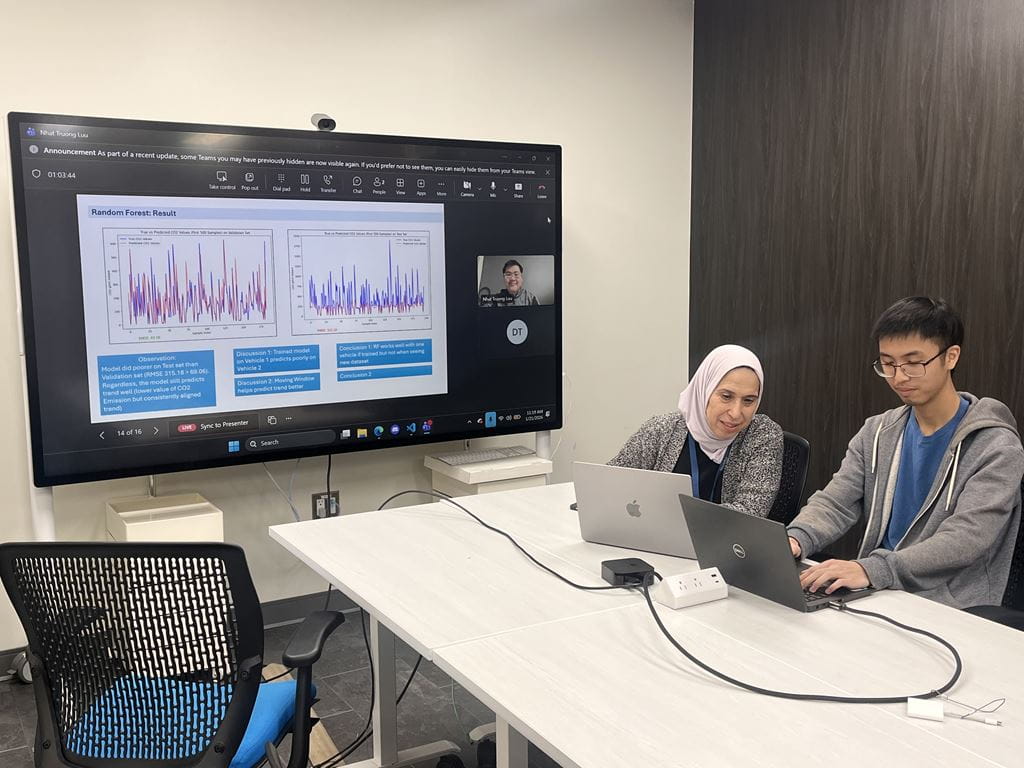
El Ghalayini’s most recent project, "Improving Urban Planning through AI, Simulation”, which is funded by an NSERC Applied Research & Development (ARD) grant and is also in partnership with Naryant, builds on this student-integrated approach. The three-year project explores how large-scale mobility data —from sources such as GPS, transit systems, sensors, video feeds and social platforms — can be analyzed using AI and machine learning to gain a better understanding of travel patterns across transportation networks. Throughout the process, El Ghalayini mentored eight student researchers whose collaborative work produced critical insights to support urban planning strategies — improving residents’ quality of life through better multimodal transportation integration, reduced travel times and decreased greenhouse gas emissions. This past summer, El Ghalayini had the opportunity to present the research outcomes to an international audience at the International Conference on Artificial Intelligence, Computer, Data Sciences and Applications (ACDSA 2025) in Antalya, Turkey, further extending the impact of the work.
El Ghalayini emphasizes the value of engaging in research at Sheridan as a powerful way to connect teaching with applied, real-world impact.
“Research allows me to bridge classroom learning with industry-driven challenges, providing students the opportunity to not only build practical skills but to see firsthand how the knowledge they acquire can be applied to shape community and industry,” says El Ghalayini. “The collaborative mentorship that takes place during these projects is central to both research quality and student success."
By bringing students into the field and embedding mentorship through the research process, El Ghalayini connects applied computing, interdisciplinary collaboration and experiential learning, advancing sustainable urban planning while inspiring students to contribute to solutions that shape more livable, accessible cities.
Interested in learning more about how to get involved as a faculty or staff member in research, innovation and entrepreneurship at Sheridan? Visit sheridancollege.ca/generator
Media Contact
For media inquiries, contact Sheridan’s Communications and Public Relations team.