
Advancing healthy aging through long-term care staff and civic participation supports
 Jul 3, 2026
 To support the well-being of older adults, Generator at Sheridan’s Centre for Elder Research (CER) is leveraging applied research to address the complex challenges associated with aging. This includes two recent projects that reflect how the Centre’s work is grounded in the belief that aging well should be accessible to all.
From strengthening mental health and social connection to supporting care environments and civic participation, both projects demonstrate how research, when shaped alongside those it serves, can lead to meaningful, real-world impact for older adults, care partners and the systems that support them.
Supporting long-term care staff through the arts
 Staff working in long-term care (LTC) often face high levels of stress, burnout and turnover. Despite the critical role these individuals play, mental health supports within LTC settings are often limited, with few evidence-based, person-centered interventions tailored to their needs. Because resident quality of care is so closely related to team members' well-being, it is crucial to support staff in this way.
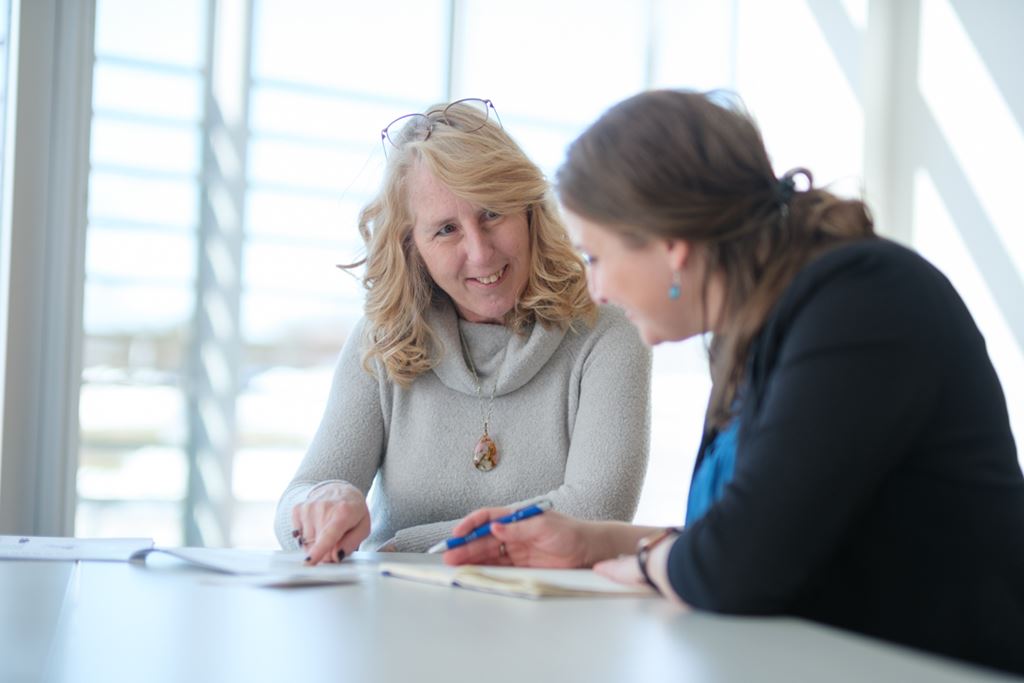
To address this challenge, CER researcher and Schlegel Innovation Leader in Arts and Aging Dr. Kate Dupuis (pictured), along with co-investigators Dr. Lia Tsotsos, Director of Research and Innovation at Sheridan, and Sheridan Pilon School of Business professor Dr. Brandon McFarlane, worked on a four-year project supported by a Natural Sciences and Engineering Council of Canada (NSERC) College and Community Social Innovation Fund (CCSIF) grant, and additional funding from the Canada Council for the Arts. In partnership with the Schlegel-UW Research Institute for Aging, Schlegel Villages, Concerts in Care Ontario, and LUCID, the research team used the power of the arts to support staff well-being and provide meaningful creative opportunities for residents.
Throughout the project, the team engaged hundreds of staff and residents across more than 20 Ontario LTC homes by delivering creative programming that integrates arts into everyday care. This included coordinating and providing concerts, visual arts supplies, and music and relaxation opportunities to enhance the workplace experience and support mental health needs of staff and residents working and living in LTC.
Project feedback gathered from staff working in LTC homes across Ontario indicates that access to concerts and visual arts supplies positively supported their well-being, empowering them to continue delivering high-quality care for older Canadians. In turn, residents benefit from these opportunities to engage creatively with their neighbours and with the staff and visitors who care for them.
“Working together with these partners and research participants over the past three years has been an incredible experience,” said Dr. Dupuis. “I am so grateful for the opportunity to have learned so much from staff working in long-term care, and it has been our team's pleasure to share those learnings more broadly with a wider audience, to support even more people across the province.”
The research team has presented the findings from this project at five local and national conferences, including those hosted by Canadian Association on Gerontology and Therapeutic Recreation Ontario, and the findings were published in academic and trade journals, including the Journal of Long-Term Care and Long-Term Care Today magazine. A final community event for the project was hosted by the project team at Sheridan on June 16, bringing together community members, researchers and partners to share insights, experiences, and innovative approaches to creative engagement in long-term care.
Community insights into older adult volunteerism
Historically, societies have leaned on the knowledge and wisdom of older adults as keepers of cultural memory, guiding decision-making, conflict resolution, and the transmission of traditions across generations. Their lived experience is often regarded as a vital resource that shapes community values and ensures continuity in times of change.
Civic engagement is often considered as an important feature of social cohesion; however, the percentage of Canadians formally volunteering with non-profits dropped from 44 per cent in 2013 to 32 per cent in 2023. When volunteering stops, individuals may lose a sense of purpose, structure and social connection, which often leads to isolation or reduced well-being. At the same time, communities lose essential support, local knowledge and the relationships that help build trust and resilience, ultimately weakening their ability to care for vulnerable members.
To help reduce barriers to access for older adults looking to partake in civic engagement, CER researcher Dr. Karen Slonim collaborated with 56 adults aged 55+ to co-design a practical guide for organizations seeking to build more inclusive volunteer environments. Supported by a grant from the Government of Canada’s New Horizons for Seniors Program, insights were first gathered through a co-designed survey that collected responses from over 200 participants and in-depth discussions that explored lived experiences. The resulting guide, ‘Facilitating Senior Volunteering: Insights from the Community’, offers actionable strategies for non-profits and government organizations, addressing topics such as ageism, accessibility, cognitive inclusion and how to support individuals to transition out of volunteer roles with dignity.
Empowering older adults by positioning them as co-creators of the solutions that affect them, the guide provides organizations with realistic, implementable strategies to improve recruitment, retention and the overall volunteer experience. As the guide is shared with government and non-for-profit agencies, it has the potential to expand access to meaningful civic participation for older adults, confront ageism, and enhance well-being. More broadly, the work contributes to a shift in how volunteerism is understood, not just as service, but as a vital component of inclusive, age-friendly communities.
To learn more about how CER is leading cutting edge research in the field of aging by examining innovative ways to enhance the well-being of older adults and the environments that support them, visit sheridancollege.ca/elder-research
Media Contact
For media inquiries, contact Sheridan’s Communications and Public Relations team.