
Applying creative solutions to quickly facilitate change
 Mar 2, 2026
 As colleges like Sheridan reimagine and refine program offerings in response to changing policies, shifting demands and financial realities, academics aren't the only ones suddenly thinking and working differently.
Sheridan's Facilities and Sustainable Infrastructure (FSI) department has also had to quickly adapt its typical workflows over the past year as the college developed dozens of new programs and expanded capacity in others. In many cases, this meant having to find creative solutions to navigate tighter time constraints, fewer resources, niche program requirements, unfamiliar vendors and other challenges.
“Renovation and repurposing projects typically take 18-24 months to complete, but we've had to move much more quickly in order to accommodate the college's recent needs.”
– Catherine Sloat, Manager of Capital and Space Planning
“Our team is always cognizant of the bigger picture, taking the time to look at things through an institutional lens because we know how much impact any space change can have on other spaces,” says Catherine Sloat, Manager of Capital and Space Planning. “That is why renovation and repurposing projects typically take 18-24 months to complete, but we’ve had to move much more quickly in order to accommodate the college’s recent needs.”
Below, we detail some of the unique hurdles presented by expanded enrolment in Sheridan’s Veterinary Technician and Welding programs and by the addition of the college’s first food-related credential, and the creative approaches FSI used to overcome them.
Veterinary Technician

Challenges of expanding Sheridan's Veterinary Technician lab at Davis Campus involved the specific needs of the space — including numerous sinks, exterior exits and a separate exhaust system — as well as the fact the lab was surrounded by computer learning spaces.
Overcoming those challenges required a two-phase approach: renovating nearby office space and a general-purpose classroom so that they could be used as two computer labs, which then freed up space for the Veterinary Technician lab to expand.
Converting the office space and classroom was the simpler of the two phases, although it still required upgrades to communication cables, power sources and ventilation. In order to turn former computer labs into a Veterinary Technician space, work included trenching plumbing into the floor, installing a new exhaust system, creating openings for exterior doors to allow animals in and out of the building, and procuring niche equipment — the latter task made more complex by an institutional mandate to purchase exclusively from Canadian suppliers.
"Overall lessons we learned from this project included to submit permit applications as early as possible to avoid delays, during tendering and construction, pre-order long-lead custom fabrication materials whenever possible, and factor external risks into commissioning and handover schedules," says project manager Shamsa Kassim. "Still, we were able to complete this project under budget and within the planned timeframe."
Nutrition and Food Service Management
 Several FSI staff had experience overseeing installations of commercial kitchens on campus, but building a 2,400-square-foot experiential learning space for the new Nutrition and Food Service Management diploma — Sheridan's first-ever program in the food industries — presented several new challenges.
Some of those challenges were alleviated by the decision to convert a portion of underutilized cafeteria space at Hazel McCallion Campus, which also provided significant cost savings by repurposing existing infrastructure such as kitchen exhausts, plumbing and gas lines, and commercial-grade kitchen equipment. However, the space still needed several upgrades to comply with code requirements for a teaching environment, including stricter fire ratings for the perimeter, the addition of smoke dampers to all HVAC penetrations, and integration into the fire alarm system.
"Ideally, we would have had more time to investigate the existing conditions of the space before starting the project, instead of relying on drawings," project manager Yumiko Kosterman says. "That led to a few unforeseen site conditions and schedule impacts, but we were able to minimize disruption to the community by closing the out-of-scope adjacent dining area after confirming with Ancillary Services that the campus had adequate communal areas nearby. Faculty also supported the project by adjusting first semester curriculum to focus more on theory and microscopy, limiting the need for access to the kitchen environment.”
Welding
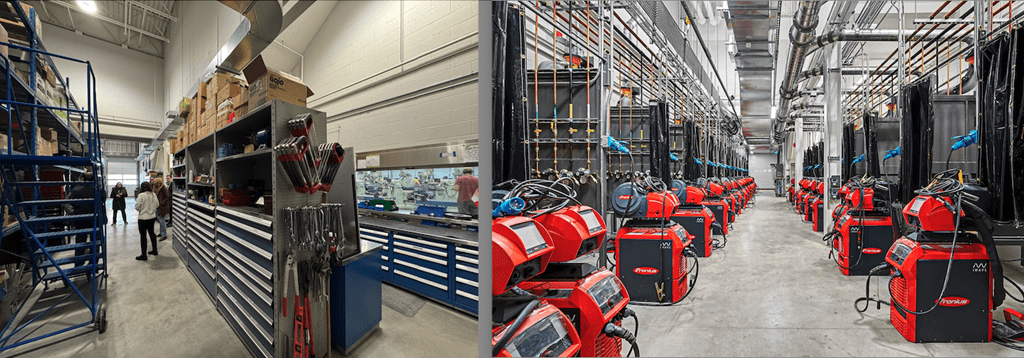
 Although Sheridan's 130,000-square-foot Magna Skilled Trades Centre already featured a welding lab, the building's purpose-designed nature made it difficult to add a second.
FSI eventually chose to convert the facility's tool crib storage and distribution centre, which was conveniently adjacent to the existing welding lab. However, with an aggressive timeline that allowed just a few months for construction, staff opted to design a completely independent system rather than tap into the original lab's infrastructure and then re-engineer for capacity.
Sheridan staff found another creative way to overcome the tight turnaround time: using a CCDC 3 - 2016 cost-plus contract system in which owners pay contractors for costs of material and labour plus a negotiated fee for overhead and profit. This allowed construction to begin before the consultancy and design phases had even been completed.
"It was quite impressive how everyone involved was able to handle the pressure of adapting to this very unconventional process," says project manager Nathan Case. "Some of that pressure was eased by everyone understanding this project would be above board and at fair market value while still ensuring vendors would all make a reasonable profit. Communication and collaboration were key."
Sheridan's Facilities and Sustainable Infrastructure team is committed to creating inspiring, inclusive and future-focused environments in which students, faculty and staff can learn, teach, work, collaborate, and innovate. The team strives to continually enhance quality, accessibility, and sustainability of Sheridan's physical spaces to ensure an exceptional campus experience for the entire community. FSI is largely comprised of graduates from Sheridan's Architectural Technology and Interior Design programs, providing a first-hand understanding of the Sheridan experience that brings a meaningful student-centered lens to their work. They draw on knowledge, creativity and practical skills developed during their studies to manage projects ranging in complexity from furniture moves and classroom renovations to infrastructure upgrades and new buildings.
Media Contact
For media inquiries, contact Sheridan’s Communications and Public Relations team.