
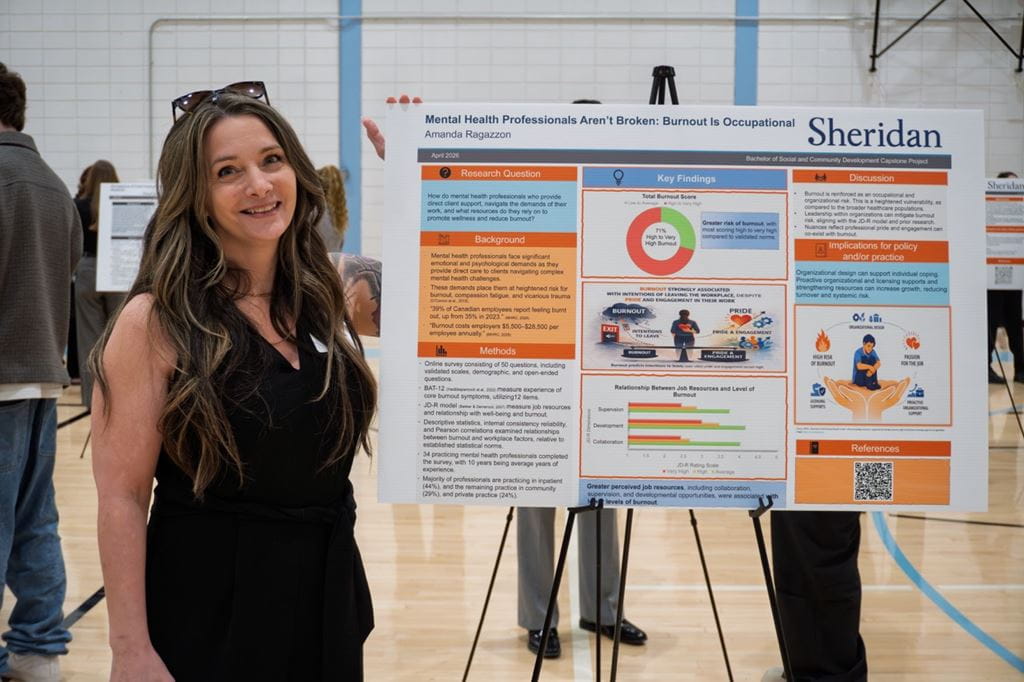
FAHCS capstones continue to unlock supports for students, faculty, researchers and communities
 Apr 28, 2026
 As degree completion programs, Sheridan's Honours Bachelor of Early Childhood Leadership (HBECL) and Honours Bachelor of Social and Community Development (BSCD) often attract working professionals eager to address systemic issues they've observed in the human services field.
Not only are students able to upgrade their diploma to a degree within a two-year span while building research, leadership and advocacy skills needed to drive positive change; they're also able to dedicate their research capstone projects to tackle real-world problems, including the very issues that prompted them to return to school.
As valuable as these capstone experiences are to students, they are tremendously beneficial to many other stakeholder groups as well. That was apparent once again at Sheridan's third annual Faculty of Applied Health and Community Studies (FAHCS) Research Symposium, a recent two-hour event at Davis Campus that attracted numerous community partners as well as administrators, faculty and staff from across the college.
Students explore issues that are important to them
Over the past year, HBECL student Sarah Newman, an educational assistant in the Halton District School Board who co-facilitates a Black student union group, investigated the need for affinity groups in elementary schools.
 "Research has shown that these groups are valuable for people to escape hostile and often oppressive elements of systemic organizations such as schools, providing positive identity development and a safe space to uplift their voice," says Newman, whose young Black-identifying son is searching for identity-affirming spaces at his school. "Affinity groups are gaining traction at the secondary and post-secondary levels of education, but not so much in elementary."
Classmate Kristin MacDonald also used her capstone project as an opportunity to research a topic that was meaningful to her: whether early childhood educators (ECEs) are sufficiently informed and equipped to work with children who have experienced trauma.
"This is an area that I'm really passionate about," says MacDonald, a registered ECE who has worked at a specialized care centre for six years. "It's sad when you are holding a baby and you know that child has already gone through some things that will set them up for some challenging years ahead. ECEs and teachers are in the unique position of working with children six to eight hours a day, five days a week, so they could help mitigate the impact of that trauma."
Meanwhile, BSCD students Jaspreet Kaur and Harleen Harleen gathered healthcare providers' perspectives on how to better engage racialized women in breast cancer screening, an issue they've observed in their own communities. "Many women ignore early symptoms due to socioeconomic barriers that limit women from prioritizing their health, the fact that cancer is a taboo topic in many cultures, the lack of a family doctor and language barriers," says Harleen. "Many healthcare policies are shaped through a colonial lens, so we hope our research can help advocate for funding to address these issues."
 The experience also showed Kaur, who had participated in focus groups before but had never led her own research, where her future passions may lie. "I'm interested in doing research now, because it's fascinating," she says. "My favourite part was analyzing our participants' responses and finding themes that indicate real issues. This capstone project was my favourite course in this program, and it's also a project we can carry on after we graduate."
Community partners are provided with findings that can drive change
Capstone research projects can provide significant support for numerous external community partners, many of which are non-profit organizations.
The Social Planning Council of Peel (SPCP) has already integrated findings from a number of projects that explored the impact of culture on the understanding of autism and access to services for immigrant families served by the SPCP and partner organizations. Several other projects explored various issues related to intimate partner violence services, a topic provided by Armagh House — Peel's only transitional shelter for women and children fleeing violence.
"We are piloting a new wrap-around family care program, the Chrysalis Project, and community-based research projects help ensure there are limited negative impacts or gaps, that we approach partners without blame and have them open up to conversation," says Thanah Sriskantha, a BSCD graduate who now works as Armagh's Community Development Manager. "The Sheridan capstone project findings were eye-opening, including how we might be able to gather survey samples through various online platforms or through places people already have personal connections with, such as churches, community organizations or Sheridan's Davis Campus."
BSCD student Mei Zhou found a different way to support her community: gauging the healthcare access and satisfaction levels of Oakville's Chinese population. "Nearly 11 per cent of people in Oakville identify as Chinese, and the nature of Chinese people is to be neutral, not saying whether something is good or not," Zhou says. "My findings and recommendations included a need to increase the number of Chinese-speaking healthcare staff, offer workshops that can help new community members navigate Canada's healthcare system, and, if possible, integrate traditional forms of Chinese medicine."
Gathering of student perspectives helps shape Sheridan's services
Sheridan's Student Services department has collaborated with BSCD since the program launched in 2023, suggesting capstone research topics that allow students to explore and improve the ways in which their peers are supported.
“(Research projects have been) a significant influence on the ways in which we support students in work-integrated learning environments.”
– Dana Brennand, Manager, Inclusive Learning
Research projects by this year's cohort included how students navigate accessibility barriers when seeking and using academic accommodations; student perceptions of food insecurity; student experiences with Sheridan's online services; and ways to increase accommodations in practicums, co-ops and field placements.
"The suggestions we provide are deliberately general, allowing students to focus on an area that they understand the most or maybe even have had personal experiences in," says Dana Brennand, Manager, Inclusive Learning. "Their research projects complement our annual student experience surveys by providing another way to gather student perspective, and they've been a significant influence on the ways in which we support students in work-integrated learning environments."
Building on Centre for Elder Research's work
Many other BSCD capstone projects build on work that is being done within one of Generator at Sheridan’s four Research and Innovation Centres, the Centre for Elder Research (CER), which conducts leading edge research in the field of aging by examining innovative ways to enhance the well-being of older adults.
Among the elder-related topics explored by this year's BSCD cohort were international home sharing, perceptions of artificial intelligence (AI) and other technologies, the impact of social isolation, barriers to volunteering, and perspectives on quality of life.
 "The ideas we provide to our students are based on what problems are presented to us by our external partners, since CER does research on behalf of and in response to the needs of organizations who are supporting older adults," says Dr. Vicki Mowat, Sheridan’s Dean of Research and Dean of FAHCS. "Our projects can spur further ideas from our students, whether it's to replicate our research, extend it or explore a different angle."
In some cases, capstone research can even lead to employment with CER's partner organizations — further strengthening Generator's relationship with the external community.
Informing and inspiring professors
Each capstone project across the symposium's three degree programs is advised by expert professors who have extensive experience in the field, including program coordinators Dr. Bethany Osborne (BSCD), Dr. Angie Rosati (HBECL) and Dr. Julie Dempsey (Honours Bachelor of Community Safety.) Other advisors include BSCD professors Dr. Ferzana Chaze and Nicole Johnson, and HBECL professors Dr. Yasaman Jalali-Kushki and Dr. Magdalena Dobrogost.
“Hearing and reading about the day-to-day challenges (students have) faced in the field helps me understand how the field is evolving.”
– Dr. Yasaman Jalali-Kushki, Honours Bachelor of Early Childhood Leadership professor
As they guide their students, faculty are also learning about the latest issues in the field and innovative solutions. "It's like professional development for us," says Dr. Chaze.
"Our students' research motivates me," Dr. Jalali-Kushki adds. "Hearing and reading about the day-to-day challenges they've faced in the field helps me understand how the field is evolving, shaping my own work in the classroom and with our community partners."
Sheridan's Faculty of Applied Health and Community Studies offers many programs that help students become citizen leaders dedicated to positive change in schools, healthcare systems and communities. Visit the FAHCS webpage to learn more.
— Pictured with their projects are (top to bottom, beginning with banner image) Amanda Ragazzon; Sarah Newman; Jaspreet Kaur and Harleen Harleen; and Norman Henry. Photos by Almira Nanez, Sheridan Social Media Specialist.
Media Contact
For media inquiries, contact Sheridan’s Communications and Public Relations team.